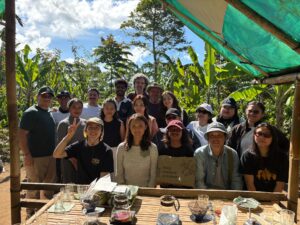
Last week I joined a coffee origin journey organized by SeedFuture, an Asia-based social enterprise that designs immersive origin journeys into ecological farming landscapes like coffee and cacao, and the communities that tend them. Their philosophy is simple: the farm is the classroom, and the farmers are the teachers. The learning then travels back with participants to the consumption hubs where most of the decisions about these crops actually get made. Their program in Bali was built with the goal of connecting changemakers working across the coffee value chain — investors, buyers, producers — with regenerative production at a farm level, focused on communities practicing agroforestry systems.
Coffee has been my passion crop since I started my journey into agroforestry and got personally involved as an investor in a regenerative coffee operation in Brazil. I’m a big believer that coffee can trail the way to scale regenerative agriculture. It’s a market growing not only in volume as the culture of coffee expands to the massive markets of China and India, but also in quality. Walk around any European capital and you will find specialty coffee shops in almost every corner. The trend has gained momentum in large cities all over the world. The variety of producing regions and different flavors one can experience in a coffee cup is today closer to wine than the shot of caffeine full of sugar that championed the market for many years. I had visited dozens of coffee farms from Latin America to Africa and now it was time to experience how agroforestry coffee works on the other side of the world, far away in Bali.
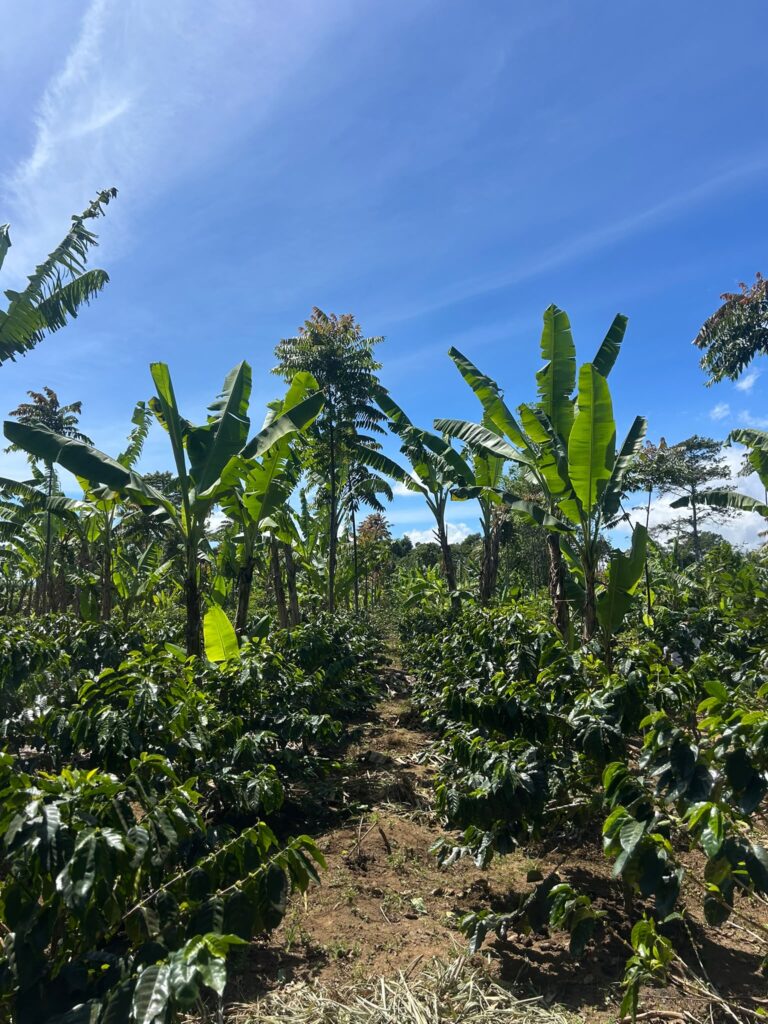
As we made our way from the spiritual tourist mecca of Ubud towards the highlands, the contrast was immense. Crowded roads full of hotels and scooters gave way to traditional villages and farmland. The temperature dropped significantly as we climbed up towards the massive volcanic mountains north of the island, and I could feel the breeze in my body that makes for a great cup of coffee at just the right height for arabica — the highlands here sit around 1,200 meters, the sweet spot for slow ripening and dense beans.
The first community we visited is located in Munduk. There an Indonesian B Corp and coffee processor called Adena has established a model farm to bring back coffee to a region where it was lost for several years. Low prices and lack of commercial incentives saw communities cutting down their traditional coffee agroforestries to give space to flower production, a thriving local market that supplies daily religious ceremonies on the island. As is the case with every commodity, as other regions started following the opportunity of flower production, prices went down and much of the farmland was sold for real estate development. Now, with the help of a professional offtaker involved with coffee production in the main coffee-producing islands of Indonesia, Adena is using Munduk as a living farm lab to test different agroforestry designs and see how they perform. What is different about this experiment from others I’ve seen is that Adena’s goals are not about increasing productivity and volumes; it’s about giving technical assistance at farm level to help communities find the best design, coupled with the best practices of post-harvest to achieve the best quality and expression of the coffee in the cup, thus creating better financial incentives for other farmers to implement agroforestry coffee. It’s a simple but radical idea: that the market itself, not just goodwill, can be the force that returns coffee to the forest it came from.
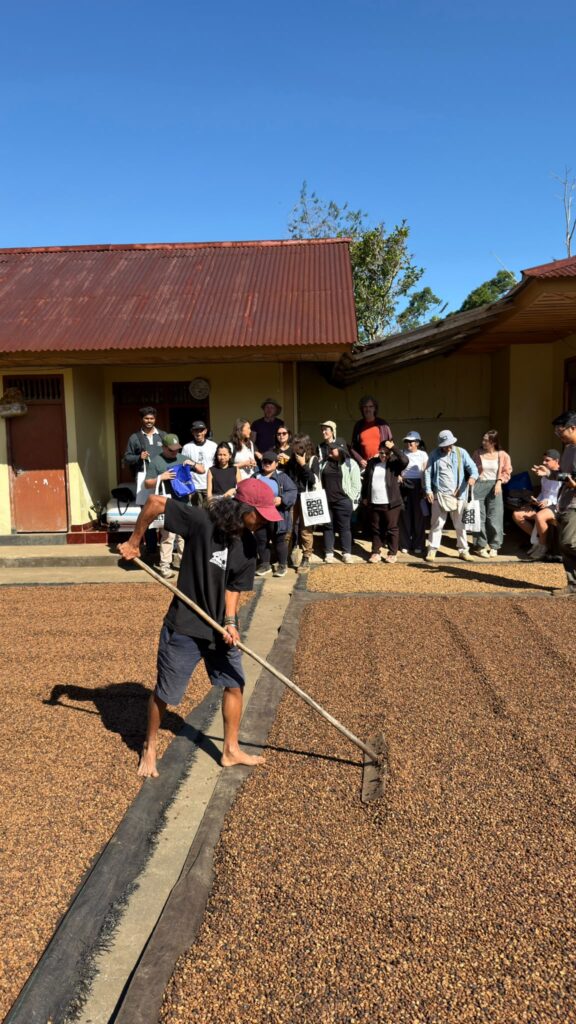
The day we visited them they were processing the cherries of their first harvest since the project started three years ago. We joined a tasting session and I was quite impressed with the quality of the coffee I tasted. The farm had a simpler version of the agroforestry, focused on service species, mainly the tree they call Dadap, a nitrogen-fixing legume, and partial shade for the arabica production, but the company was interested in the results of more diverse agroforestry that includes fruit species like papaya, banana and pineapple. Not because of the market value of these crops, but for the possibilities of taste notes these fruit trees could express combined with coffee.
The full expression of taste when we combine coffee trees with fruit trees was exactly what we experienced and tasted for ourselves in the community we visited the next day in Kintamani, Bali’s largest coffee-producing region and one that is getting origin recognition around the world. In Kintamani all you see when you drive through the region is agroforestry. There is hardly any attempt to do coffee as monoculture. The most common design you can see all around is coffee paired with citrus trees producing small local mandarins. The reason for that, we found out, was purely driven by commercial forces. As coffee prices came down years ago, producers looking for more profitable crops moved to citrus trees, especially mandarin. As the volatile forces of commodity-driven markets brought the mandarin prices down, farmers started looking at coffee again, but now most of the coffee trees were gone.
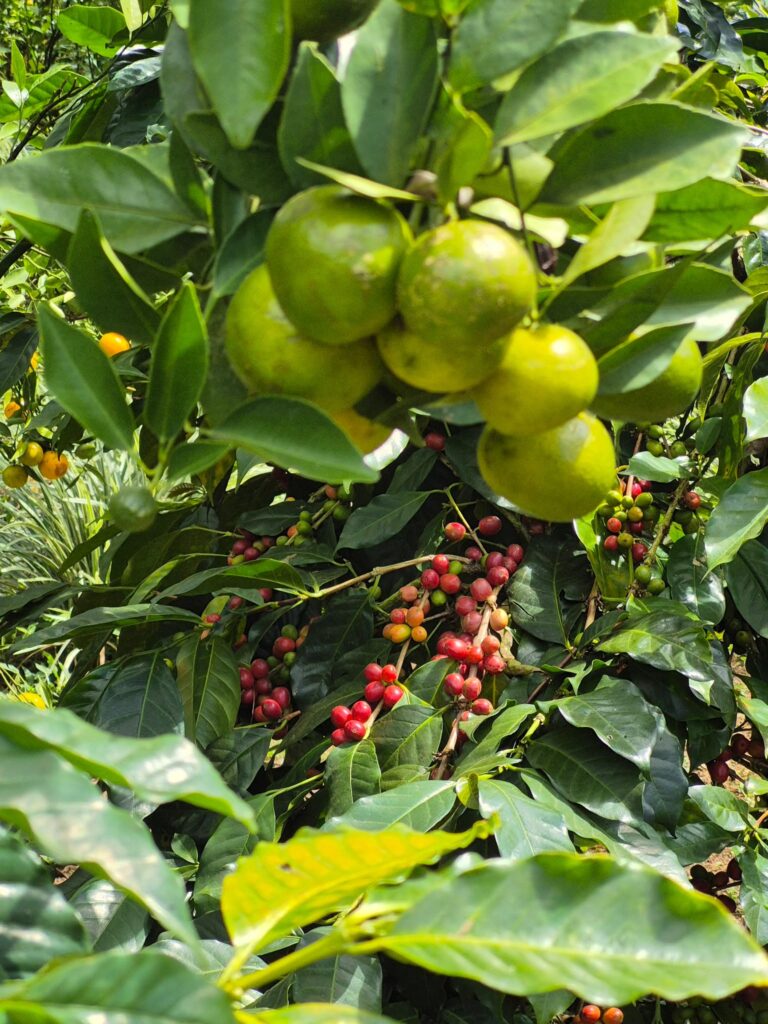
In the community we visited, farmers partnered with Kopernik, an international development organisation researching and promoting best regenerative practices in coffee production. There they were back in dense agroforestry systems pairing mandarin trees very close to coffee trees. The community had plans to bring back the higher layer of the traditional agroforestry systems, with larger trees that were all cut down long ago for timber, and they were also experimenting with ginger and turmeric as well as other food crops at the feet of the coffee trees. The combination of the two trees that drive soil acidity was a surprise to me, but something in the dark volcanic sandy soil was making that symbiosis work as farmers observed how each tree played a role in controlling pests that affect the other tree. The coffee tree, they told us, seems to draw nematodes away from the mandarin roots, while the mandarin in turn keeps fungal pressure down in the coffee’s root system — a kind of mutual protection racket, worked out through generations of observation rather than any lab. No one could tell us exactly why it works. It just does. Most of the development is done by trial and error through observation, and I was left wondering what a soil scientist would find in these soils that makes the system work in this location so beautifully.
Another curious aspect of their production system is that both mandarin and coffee harvests overlap. As we wondered how the community could cope with the labour needed during pick season, the response of the farmer was a beautiful illustration of why the best coffee is found today in smallholder farm communities that have the luxury of post-harvest technical assistance and access to markets. He looked at us with a big smile and said that everyone in the community comes to the farm to help with harvest, and especially the elders who experience harvest time as a special moment to reconnect with the community through work in the field.
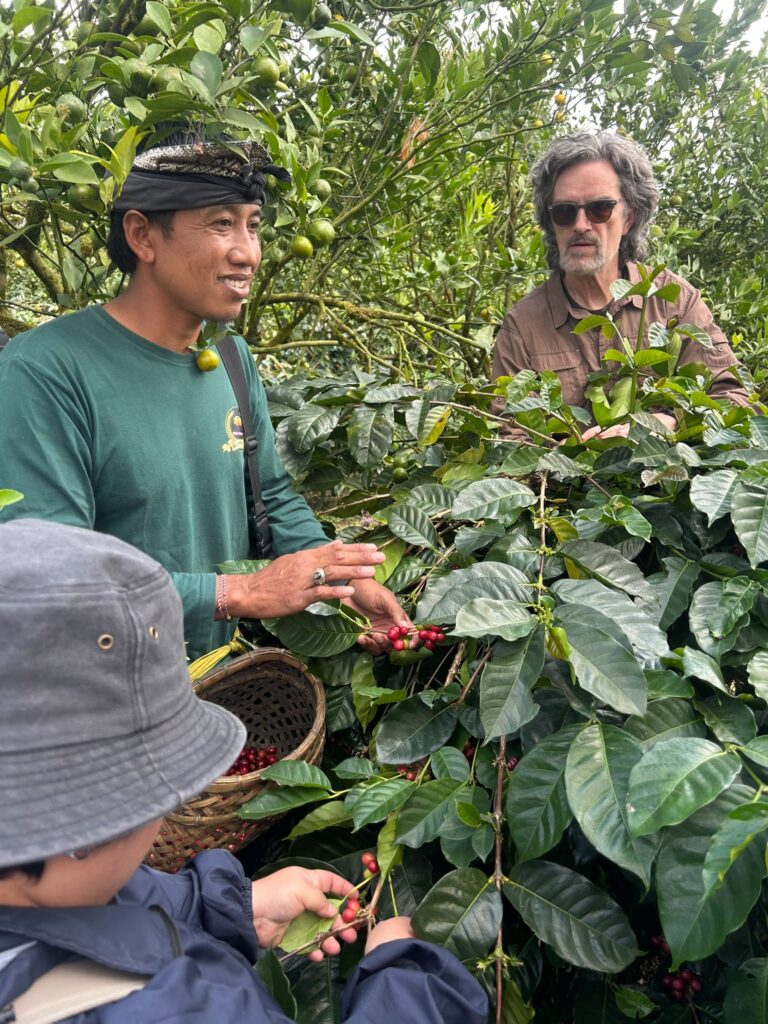
Coffee well done is a community effort. This is what allows them to pick cherry by cherry and cope with a multi-crop harvest in the same season. Their diverse agroforestry also supports the production of many delicious local food crops that were waiting for us as a snack welcome banquet in their community hall. As we feasted on the farm goods, a group of local baristas prepared a cupping session so we could try the fresh harvest of that month roasted by a local partner.
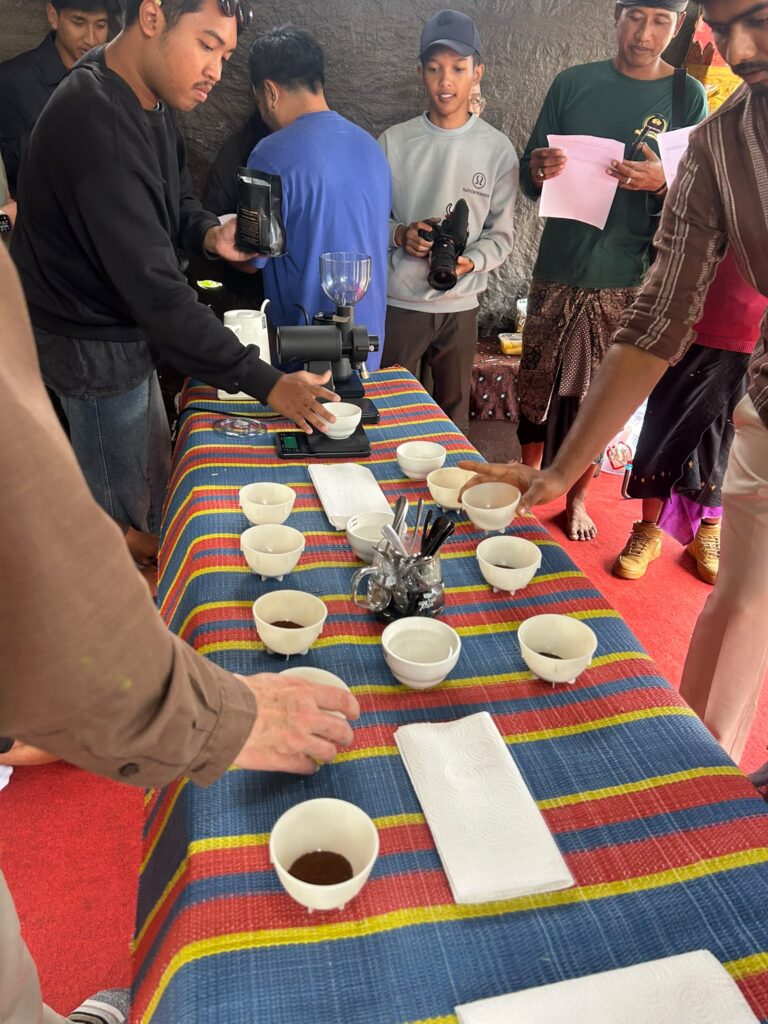
It was the first time the community was receiving a group of foreigners with coffee experience in their land, and everyone came out to see that strange international group smelling cups of coffee and drinking them with a spoon, making weird noises and elaborate notes on a scorecard. Looking at the puzzled faces of the elders, it is clear that there is not only a disconnect between the consumer and the farmer, but also a complete disconnect between the farmer and the consumer when it comes to how and why their products are consumed. The gap between the farmer’s definition of quality expressed into a beautiful fat red coffee cherry that stays in the bottom of the bucket when the coffee is washed, versus the smell and taste of complex notes of a coffee cup at the end of a long process of handicraft in turning those red cherries into that beloved hot black beverage.
Bali has one more deep unique twist to the beautiful complexity of coffee. Its spirit. It was beautiful to hear from two small producers practicing their own traditional version of biodynamic production, about all the rituals and ceremonies performed in every stage of the coffee production. The final product of their labour of love is sitting on my desk now in a 300-gram bag of coffee that they sold me for 100,000 IDR, roughly 5 Euros. It felt so cheap for all that work of love. The reality is that the huge majority of producers, alienated from the processing stages of the supply chain, sell their coffee in the form of raw cherries for cents that, at the end, represent a tiny percentage (1 to 3%) of what you paid for that 4-euro cup at your local third-wave specialty coffee shop, which often gives you the origin on the bag and sometimes even the name and face of the farmer. The reality unfortunately is that most of the value stays at the end of the supply chain far from the country that produced it.
On our third and final field day, we visited the most beautiful coffee-producing area of the trip in Wanagiri. Here the seeds of a bioregional project were planted long ago, but it took the leadership of Pak Made, a local community leader, to get seven villages who used to compete for the area’s natural resources to work together to protect and restore a beautiful forest that hosts the key water springs that feed the whole valley. Pak has led the community coffee initiative that now has its own processing facility and roastery. It lacks the post-harvest infrastructure needed to produce specialty coffee, but it’s already improving its product to service the local hotel industry.
We didn’t get to walk their agroforestry plots that day, but from what we heard, Wanagiri’s systems mirror the structure we saw in Munduk. What’s still missing is a partner like Adena to lead the post-harvest and processing side, so the work here feels more experimental and community-led, still finding its footing. One detail stayed with me from what we did see: farmers were grafting arabica onto robusta rootstock, letting the hardier, disease-resistant roots of robusta anchor a tree that could still produce the more delicate cup of arabica above ground — a small act of adaptation, marrying the toughness of the forest’s native constitution to the flavor the market wants.
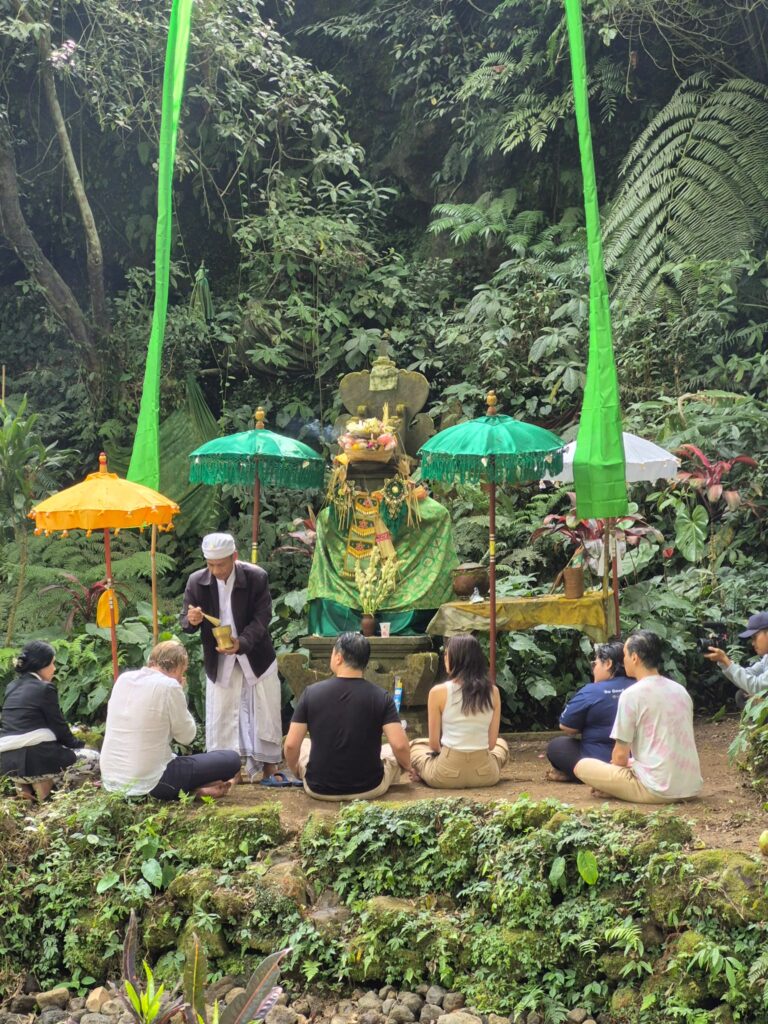
We walked with Pak and community members through their precious forest full of waterfalls all the way to the natural spring where we took part in a water blessing ceremony. It was beautiful to take part in a traditional ceremony that worships water as the most sacred element. Even with the support of Balinese spiritual traditions, the lack of joint community governance over the forest was leaving it exposed to degradation, with flower plantations popping up on the margins of rivers and close to the natural springs. Under Pak’s leadership, the areas are being reforested and coffee is being added as a cash crop in agroforestry systems to provide community income.
As I sip a cup of Kintamani coffee in my home in Amsterdam, probably too late for a caffeine kick, my cup now has a whole new blend of taste and aromas — all the stories I heard and experienced from communities producing coffee in different systems, but with the same underlying principle of symbiosis with the natural landscape.
I started this journey believing coffee could trail the way to scale regenerative agriculture. A week in Bali didn’t just confirm that belief, it gave it roots. The same market forces reshaping coffee into something closer to wine — origin, elevation, varietal, story — are the ones giving farmers a reason to bring the forest back into their fields. In the midst of the summer of 2026, when we are witnessing climate collapse all around us, my hope is that if only humanity could get this one beloved plant produced right, imagine the positive impact we could have. The plant that domesticated us so successfully that we spread it from the gardens of Ethiopia all over the world onto large monoculture plantations, dependent on an eternal flow of chemical inputs to keep it in decent health and hyper-productive, might also be the plant that shows us the way back. Bring it home to the forest, pair it with the right neighbors, let the community read the signs the land gives — and the more coffee we drink, the more we restore degraded land, removing carbon from the atmosphere and supporting biodiversity while improving community livelihoods. Sounds like utopia, but it does have a promising business case behind it. Thank you, SeedFuture, for bringing the real story of coffee and its possibilities, closing the gap between farm and cup.
To learn more about the next origin journeys, check out
www.seedfuture.org or follow @seedfuture25 on Instagram.